How should contemporary young people use Liang Qichao’s ideological resources
Liang Qichao can be said to be one of the earliest scholars in modern China who realized the "modernity dilemma" of young people who were "anxious, hectic and bored". In this regard, he put forward the outlook on life of "interestingness" and "exhaustiveness", advocated the methods of self-cultivation of "introspection and self-denial" and "conscience", and tried to help young people find spiritual sustenance and establish independent personality, thus changing the atmosphere of the times.
"Liang Qichao’s Self-cultivation Series" was recently published by Shanghai Ancient Books Publishing House, among which "Thirty Lectures to New and New Youth" recorded the speeches made by Liang Rengong to young people in the 1910 s and 1920 s. The reason why these listeners are called "new young people" is that they are already a new generation compared with the "new youth" of the May 4th generation. The purpose of Liang Qichao’s speech to these "new young people" is to "save the young people": "The saddest thing in the world is to watch a group of good young people go bad step by step." Liang Qichao called the education at that time "selling intellectual grocery stores". Although this kind of education was "new education", it was already riddled with ills. So he shouted to the young people: "Gentlemen! Do you want to be a man after all? No, you should know the danger! No one can save you unless you brace yourself and try to save yourself! "
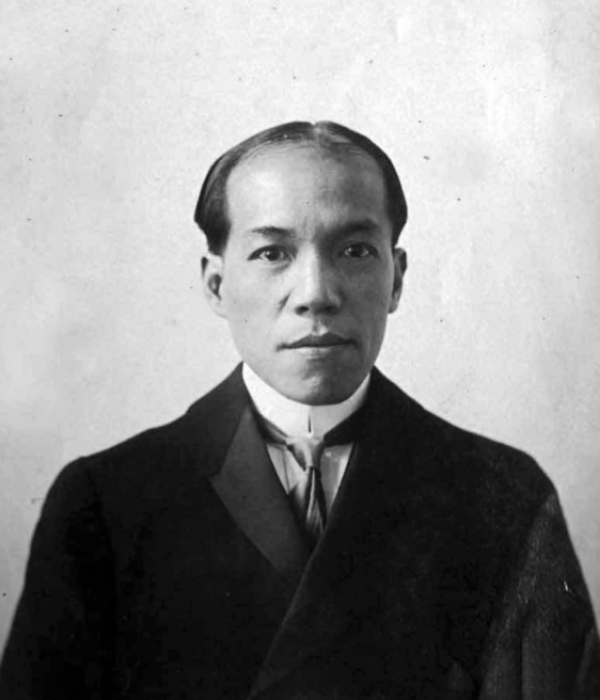
liang qichao
Recently, Shanghai Ancient Books Publishing House invited Professor Xu Jilin from the Department of History of China Normal University, Professor Deng Bingyuan from the Department of History of Fudan University, and Professor Tang Xiaobing from the Department of History of China Normal University to be guests at the flagship store of Duoyun College in Shanghai Center, and held "Young people, what are you worried about?" The reading sharing meeting and the new book release activities will discuss the contents of Liang Qichao’s speech on "new and new youth" and how young people today should face the problems of spiritual emptiness and confusion and anxiety.
"Interest Doctrine" and "Exhaustivism"
Xu Jilin first proposed that Liang Qichao was a real enlightener. Liang Rengong founded Xinmin Congbao in 1902 and began to serialize a series of articles, Xinmin Shuo, which had a far-reaching influence. In his view, compared with the radical anti-traditional revolution launched by Chen Duxiu, Hu Shi and others, Liang Qichao advocated a relatively moderate change, so as to connect tradition with modernity, the west with China and open another path of enlightenment. According to Xu Jilin, the theme of these 30 speeches was not "Mr. De" (democracy) and "Mr. Sai" (science), but "Miss Mu" (Morality). The core view of Liang Qichao’s series of speeches is that morality fosters people and morality establishes the country. According to him, Liang Qichao initially distinguished the concepts of "public morality" and "private morality" and thought that the lack of elaboration of "public morality" in China’s traditional morality led to the failure to achieve equality before the country; Later, Liang Qichao traveled to the west and began to realize that "public morality" is also based on "private morality", and advocated the thought of "pushing oneself and others" and "domesticating the country" in Confucianism.
In Xu Jilin’s view, Liang Qichao’s thoughts have a strong sense of reality, and many of his opinions can only be understood if they are placed in the ideological context at that time. For Liang Qichao, Chinese studies should not be the knowledge of knowledge and literature, but the knowledge of virtue and the philosophy of life. According to Xu Jilin, when talking about morality, Liang Qichao emphasized "self-discipline of will". In his speech, Liang Qichao quoted the sentence in The Analects of Confucius, "The knower is not confused, the benevolent is not worried, and the brave is not afraid", and combined with modern psychology, he thought that a person with complete personality should include three parts: knowledge, emotion and meaning. Xu Jilin said: "I have always stressed that in addition to IQ and EQ, today’s students also need’ willpower’, that is, I think Liang Qichao is my bosom friend".
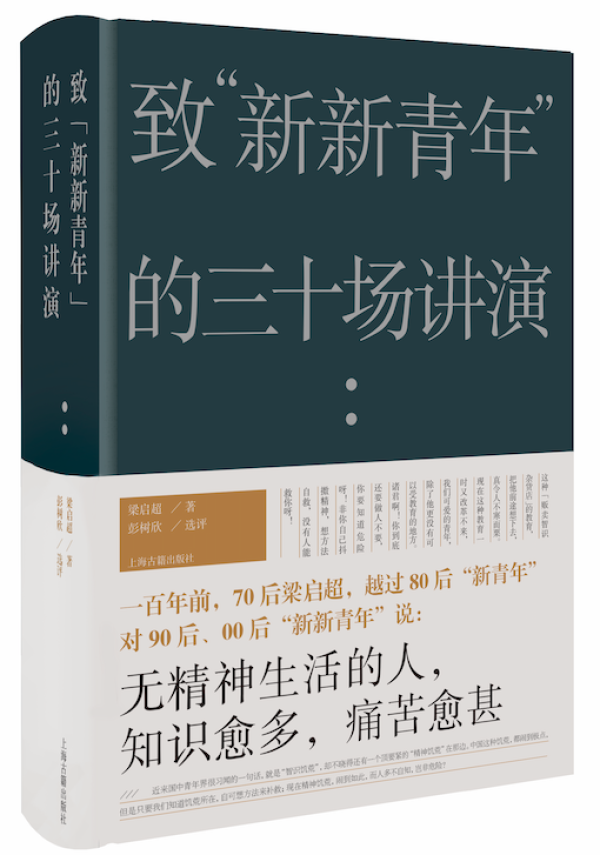
Thirty speeches to "new and new youth"
Xu Jilin went on to add that another point that Liang Qichao emphasized in his 30 speeches was "perfection", that is, giving full play to his own personality, thus forming an independent personality. In Xu Jilin’s view, today’s young people also face this problem: how to realize their own personality. In this regard, Liang Qichao put forward "interesting doctrine". According to him, Liang Qichao, by reflecting on his early political life, found that to do one thing well, the most important thing is to be interested in it, so as to be "never tired of it". Whether you are working or studying, you should avoid utilitarian ideas and be guided by your own interests. The ancient culture of China attached importance to the "happiness" in the process of life, which represented the quality of life and the realm of life pursued by the ancients. Confucius talked about "music" many times, and Xu Jilin quoted "the one who knows is not as good as the one who enjoys it, and the one who enjoys it is not as good as the one who enjoys it" in The Analects of Confucius, explaining Liang Rengong’s "interesting doctrine": interest is the motive force of life, and without it, life will lose its meaning.
Find a balance between morality and knowledge, internal and external.
Deng Bingyuan first talked about the "new and new youth" in the topic. The audience of Liang Qichao’s lecture was "post-90 s" and "post-00 s" at that time, and Liang Qichao himself was "post-70 s", which is similar to the age structure of our new book sharing meeting today, with a time difference of just a hundred years. Deng Bingyuan bluntly said that Liang Qichao was a genius, and he also had remarkable experiences in his early years, so he was involved in the complex political and ideological trends in the late Qing Dynasty. What is rare is that Liang Qichao was not completely caught up in the social tide. In today’s words, he kept his "initial heart" as much as possible: Liang Qichao worked as the chief justice and chief financial officer in the Beiyang government, but later entered the academic world but completely recovered his true colors as a scholar and did not miss politics.
Deng Bingyuan pointed out that Liang Qichao attached great importance to the method of self-cultivation, and explained it. For Liang Qichao, the key to "conscience" lies in "obeying the first command of conscience", and he also practiced this method of self-cultivation with his own life. From Liang Qichao’s speech at the Shanghai Youth Conference in 1917, we can see that Liang Qichao summarized the specific self-cultivation efforts into three aspects: first, develop the body and pay attention to the cultivation of "animal character"; The second is to obey the first command of conscience when the beast (human physiology and desire) conflicts with the godhead (human spirit and reason); Third, expand one’s personality, make individual personality consistent with social personality, and combine small personality into big personality.
Deng Bingyuan then pointed out the "Guimao school system reform" as the historical background for us to understand Liang Qichao’s thought. Since the late Qing Dynasty, the original knowledge system in China, that is, the imperial examination system with the content of "the subset of classics and history" began to disintegrate, and schools in China began to adopt a new education system. According to Deng Bingyuan, the idea of anti-tradition and total westernization was put forward before and after the Reform Movement of 1898, but its influence gradually increased later, and the fundamental reason was the changes in the education system and school system. The following question is how to treat the original classics, especially the classics of "Confucian classics". It should be noted that the "subset of classics and history" is not only a knowledge system, but also the spiritual sustenance of the ancient people in China. Therefore, after the educational reform, the phenomenon of "spiritual famine" appeared as Liang Qichao said.
In Deng Bingyuan’s view, "Confucian classics" can serve autocratic monarchy, freedom and life. In view of the background of the educational system reform, Deng Bingyuan gave another explanation to Liang Qichao’s thirty speeches: "Although Liang Qichao was talking about morality, he didn’t talk about how important morality is in the abstract. He actually hoped to establish a balance between morality and knowledge, between’ inside’ and’ outside’, which is just like the balance of wisdom, benevolence and courage just mentioned. If a person just goes in the moral direction, there will be problems. " Deng Bingyuan summed up the shortcomings of China’s traditional culture as "making a cocoon and tying itself up", while the problems of western culture are more like "giving up on a cliff", which is also the difficulty we will face when studying and thinking today. The continuity and balance between the two need more efforts.
Culture has more dignity than power, and learning has more life than politics.
Tang Xiaobing said frankly that this book moved him very much. In his view, the era we live in today is still very similar to that of Liang Qichao. We should explore in different ways and reflect and choose in learning from the West. He lamented: "Liang Qichao’s speech to young people at that time contained many feelings of his own. We were faced with unresolved modernity and it was impossible to go back in the past." For today’s anxiety and boredom, Tang Xiaobing thinks that we should not only stay as the "light" of the world, but also be the "salt" of the world, and live out the contradictions of the times in ourselves.
In Tang Xiaobing’s view, for the young people of Liang Qichao’s era, they are facing a revolutionary era and an era of high ideological concentration, so they will also face the same problems as today’s young people, and Liang Qichao’s speech is a sincere response to these real problems, which makes us feel moved. Tang Xiaobing specifically mentioned Liang Qichao’s speech on "Cultivation of Politicians" in Tsinghua University in 1925. Liang Qichao saw that politics was becoming a de-moralized and de-ethicized transaction form, so he emphasized the significance of virtue education, which is still very enlightening to us today.
Tang Xiaobing then mentioned Liang Qichao’s idea of "being a first-rate person". For Liang Qichao, it is important to discover the intrinsic value of each profession, and it is not necessary to grab social resources and dominate others to the greatest extent before you can get a sense of dignity. Liang Qichao’s emphasis on "being a first-rate person" is a person who wants to stick to the former meaning. In Tang Xiaobing’s view, Liang Qichao’s "interest doctrine" reflects his attitude of affirming life, loving life and seeking self-meaning in the dignity of every profession. In the face of our sense of tiredness and boredom about life today, we should return to the "interesting doctrine" advocated by Liang Qichao in his speech. Tang Xiaobing quoted Liang Qichao’s words to explain his choice and self-adjustment in his later years: culture has more dignity than power, and academics have more life than politics. Tang Xiaobing believes that if Liang Qichao is against "exquisite egoists" and "dynamic nihilists" today, he will hope that young people will embrace life and times more broadly and become individuals who are conscious of their own culture and significance.