The old enemy in the Middle East shakes hands in Beijing. This photo is meaningful.
On March 10th, a big news shocked the whole world. Saudi Arabia and Iran agreed to resume relations after breaking off diplomatic relations for seven years, and the place to reach an agreement was in Beijing.
A photo shows Wang Yi standing in the middle, with Saudi Minister of State, Cabinet member and national security adviser Eban and Iranian Supreme National Security Council Secretary Shamkhani holding hands and smiling.
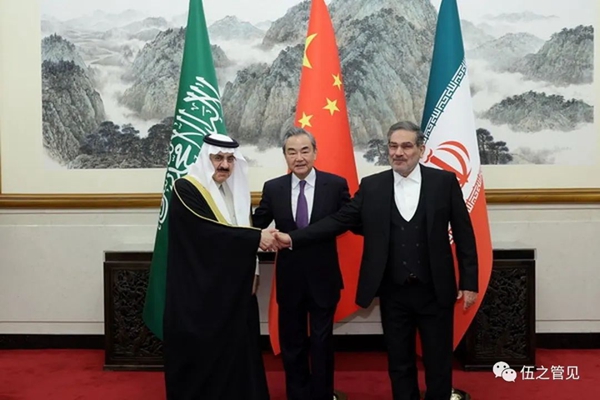
This is a long-lost good news for our turbulent world.UN Secretary-General Guterres issued a statement through a spokesman, welcoming the decision of Iran and Saudi Arabia to resume diplomatic relations, and thanking China for assisting relevant consultations. Countries in the Middle East are also applauding. Oman, Qatar, United Arab Emirates, Kuwait, Egypt and other countries have issued statements of praise.
Why did the international media seize the news spot in China?"Iran and Saudi Arabia agreed to resume relations with the help of China," read the headline of the Associated Press. AFP directly labeled the agreement as "Made in China". The Economist reported that it was amazing enough for two old enemies to sit together, but it was even more surprising that the meeting was held in Beijing, not the capital of a Middle Eastern country.
Goodwill and reliability
The joint statement of China, Saudi Arabia and Iran shows that the Saudi and Iranian delegations held talks in Beijing from March 6 to 10. The time for the talks was fully calculated, totaling five days.
Shay’s dialogue is nothing new. Since April 2021, officials of the two countries have started a dialogue in Baghdad, the capital of Iraq. Before this round of dialogue in Beijing, the two countries had held five rounds of dialogue, the latest one was in April 2022.
To tell the truth, many people didn’t expect Shay to negotiate before. After all, the two sides are old enemies. This time, the negotiation process, which has been put on hold for nearly a year, made a breakthrough in just five days, which made many people exclaim that China’s diplomacy has brought great surprises to the world. The United States, Russia and India can’t do this, only China.
So, why China? Wang Yi gave two key words: China is a "goodwill" and "reliable" mediator.
First, China has good intentions.
Countries in the Middle East suffer from the interference of big powers. Historically, western colonialists imposed western institutional culture on the Middle East, arbitrarily dividing boundaries in the struggle for spheres of influence, laying a hidden danger for nation-state conflicts. Some big countries have adopted the strategy of "divide and rule" against Middle East countries, encouraging ethnic and religious conflicts, so that they can only embark on the road of "dependence". After the end of the Cold War, the United States expanded aggressively in the Middle East by military means, forcibly promoted regime change and democratic export, and further deepened the suffering of countries in the region.
For western powers, a United and powerful Islamic world is not in line with their strategic interests, but a weak and divided Islamic world is in line with their wishes.
Unlike western powers, China has no geopolitical historical debts in the Middle East and has never been involved in geopolitical struggles. China and the countries in the Middle East share a common memory of the harm of colonialism and imperialism, and also have similar pursuits of national liberation, independence and self-improvement.
This is why China has repeatedly said today that "the Middle East belongs to the people of the Middle East, and the fate of the Middle East should be in the hands of the people of all countries in the Middle East". Although the West always smears China for filling the "power vacuum" in the Middle East with a mean heart, the choice of China by Saudi Arabia and Iraq to mediate just shows that the Middle East countries believe in China’s public interests and cherish this goodwill.
Second, China is very reliable.
If China is not believed to be reliable and China can accomplish this great event, the two sides will not accept Chinese mediation after the dialogue is interrupted.
Shamkhani, the Iraqi representative, said that he appreciates China’s constructive role in supporting the development of relations between countries, which is necessary to solve challenges, promote peace and stability and promote international cooperation. Saudi Arabia’s representative Eban said that he hopes to continue constructive dialogue with Iran and appreciates the positive role played by China.
In recent years, China has played a more and more constructive role in hot issues concerning regional and global security and stability, and its fair and reliable image has been deeply rooted in people’s hearts. China put forward the global security initiative, attached importance to the legitimate security concerns of all countries, and persisted in resolving differences among countries through dialogue and consultation … …
Of course, the global security initiative is not empty talk, and the Shay dialogue has become a successful practice to effectively implement the global security initiative.
Someone is stimulated.
America’s main ally and number one enemy in the Middle East actually shook hands and made peace … … While the international community is celebrating, Americans have mixed feelings and intriguing responses.
The first move is to make amends and try to get back face. John Kirby, the strategic communication coordinator of the White House National Security Council, responded that although Washington was not directly involved, Saudi Arabia let American officials know about its talks with Iran.
If Saudi Arabia really respects and trusts the United States, will it reconcile with the enemy in the eyes of the United States?
The second measure is mouth shut, which will selectively blind China. When asked about China’s unusual role in helping United States ally Saudi Arabia and enemy Iran to achieve unity, Kirby Gu said that the White House believed that internal and external pressures, including Saudi Arabia’s effective deterrence of Iran and its agents’ attacks, finally brought Teheran to the negotiating table.
I really want to add a question for the reporter: Why is the negotiating table in China?
The third measure is to smear and think that China has ulterior motives. Kirby said that he will continue to pay attention to China’s "gaining influence and foothold in other parts of the world".
The United States has always measured people by themselves. In the eyes of the United States, China must have a purpose in doing this, and it must be plotting geopolitical expansion.
To sum up, the United States is obviously stimulated for many reasons.
The United States has long manipulated and intervened in regional affairs in the Middle East by "pulling one faction to fight another", and the long-term discord between Iran and Saudi Arabia has provided space for American intervention. The United States exaggerates the Iranian threat, intensifies the contradiction between regional countries and Iran, builds a regional alliance against Iran, and takes the opportunity to sell arms. How can the United States engage in a small circle in the Middle East in the future?
Reconciliation between Iran and Saudi Arabia will be conducive to easing a series of crises and contradictions in the region, including the Yemen crisis and the contradiction between Syria and regional countries. The United States does not want to see a peaceful Middle East, because it is difficult to profit from chaos.
Reuters commented that China’s role as a peacemaker in a region where the United States has long exerted influence has deeply disturbed Washington.
With China successfully mediating the contradiction between Iran and Saudi Arabia, China will become more and more popular in the Middle East, and it will be smoother to deepen cooperation with regional countries and promote the high-quality construction of the Belt and Road Initiative.This is also a reason why the United States is stimulated.
Finally, go back to that photo, which is a victory of peace and a true aspiration of the people.