Sprint trillion enterprise service track, human resources digital service providers scuffle

In the three years since the epidemic, China has experienced a great change in the digital economy, and telecommuting has driven the enterprise service sector to be hot. Under the pressure of the overall economic environment this year, a number of digital human resources service providers are still welcoming new trends in the capital market.
In January 2022, Beisen Holdings, a cloud human resource management (HCM) solution provider, submitted the form to the Hong Kong Stock Exchange, striving for "the first share of HR SaaS", and submitted it again in July.
Almost at the same time, CDP Group, the HCM SaaS+ platform, also submitted a prospectus to the Hong Kong Stock Exchange in February this year, and delivered the form twice in August.
In May, 2022, the overall human resources SaaS solution provider announced that it had obtained 300 million yuan in Series D financing.
In June 2022, Yunsheng Group, a one-stop human resources digital service cloud platform, announced the completion of the 270 million yuan Series C financing.
In November, 2022, HR SaaS service provider Yilu announced the completion of series D financing of 1 billion yuan.
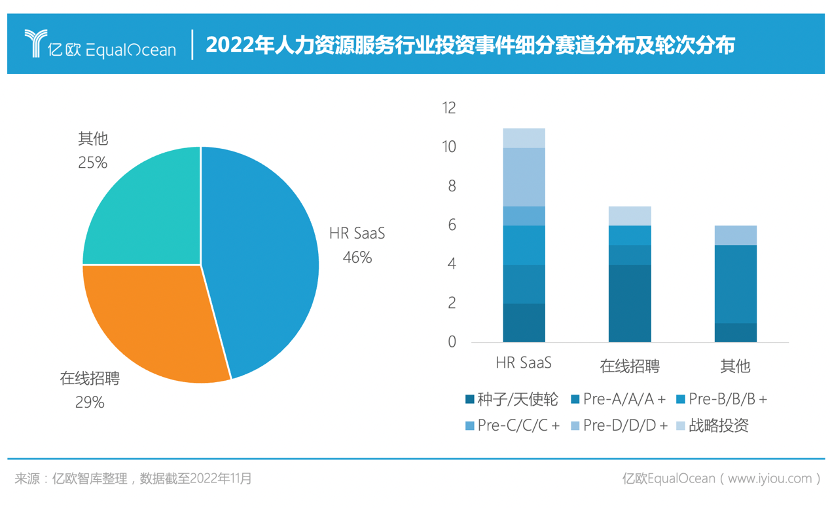
Behind the capital boom, there is no lack of controversy. The market structure is scattered, the profit expectation is slim, and the growth space is unknown, which makes the outside world have many doubts about the digitalization of human resources.
In this regard, Yiou think tank will be released in early December.Research Report on Digital Development of Human Resources in China in 2022, and held a report interpretation forum salon at the same time. Through in-depth interviews with industry experts and case studies of several leading enterprises in the industry, Yiou think tank makes a judgment on the development trend of digital transformation of human resources from the perspective of different scenarios, difficulties and pain points of enterprise transformation, so as to help enterprises clarify the direction of transformation and look forward to longer-term development opportunities in the future.
The following is a catalogue of some of the highlights in the report, which decodes the new trend of human resources digitalization in advance:
To understand the digitalization of human resource management, we need to clarify the main functional sectors of human resources first.
Human resource management is to rationally allocate human resources in a planned way according to the requirements of enterprise development strategy. Through a series of processes such as recruitment, training, use, assessment and encouragement, employees’ enthusiasm is mobilized, their potential is brought into play, and value is created for the enterprise to ensure the realization of enterprise strategic objectives.
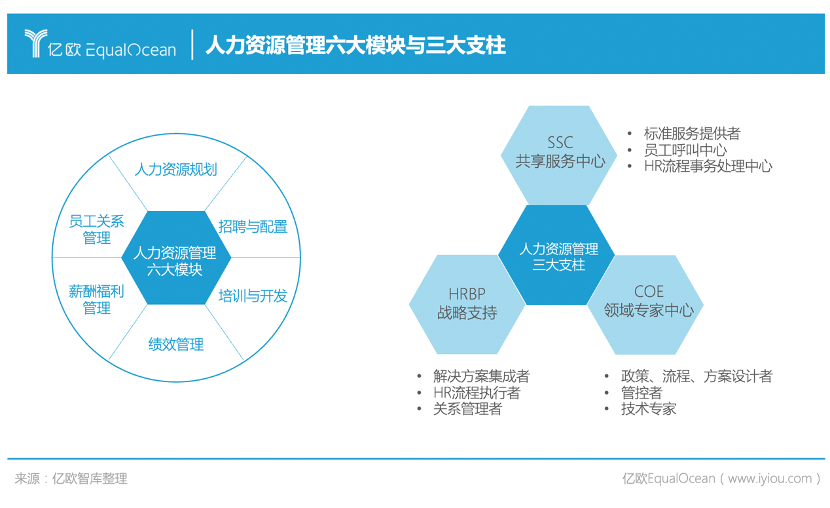
Human resource management, that is, the functional scope of the "HR department" we often refer to, can be divided into six modules according to business types, namely, human resource planning management, recruitment configuration management, training development management, salary management, performance management and employee relationship management.
Each module is closely related, but the specific work division has its own focus. At present, "human capital" has changed from function-oriented to business-oriented, and the role of HR is divided into three parts, namely, the "three pillars" of HR, expert center (COE), HRBP (business partner) and SSC (shared service center).
The digitalization of human resource management refers to creating a unified digital workplace through the new generation of digital technologies such as mobile Internet, cloud computing, big data and artificial intelligence. Through digital human resource management, we will build a human resource supply chain that meets the needs of enterprise strategic development, realize the process and automation of human resource management, and realize the digital operation of human resources in all fields; Enhance the overall experience of employees through intelligent employee service; Through intelligent analysis, help organizations make scientific human resource management decisions.
From 1980 to now, human resource management has experienced a continuous iterative and evolving transformation process, which has gone through four stages: personnel management, human resource management, strategic human resource management and talent operation and governance. In the digital age, the digitalization of human resources no longer focuses on specific tools and skills, but uses digital talents, digital tools, digital management and digital scenes to upgrade human resources management in an all-round way and complete the transformation from "E-HR" to "D-HR".
At present, the digital transformation of human resources in China is still in the early stage, and the degree of digital penetration among different industries and enterprises is quite different. It is understood that 55% of enterprises have realized process automation, and are in the initial or advanced stage of digitalization, of which only 7% are relatively mature in digitalization, but 45% still adopt traditional human resource management methods and have not yet undergone digital transformation. In 2020, the digitalization rate of human resources management in China is only 4.9%, and the overall market scale of human resources service industry has exceeded 2 trillion yuan, so there is still huge room for development in the digital human resources solution market.
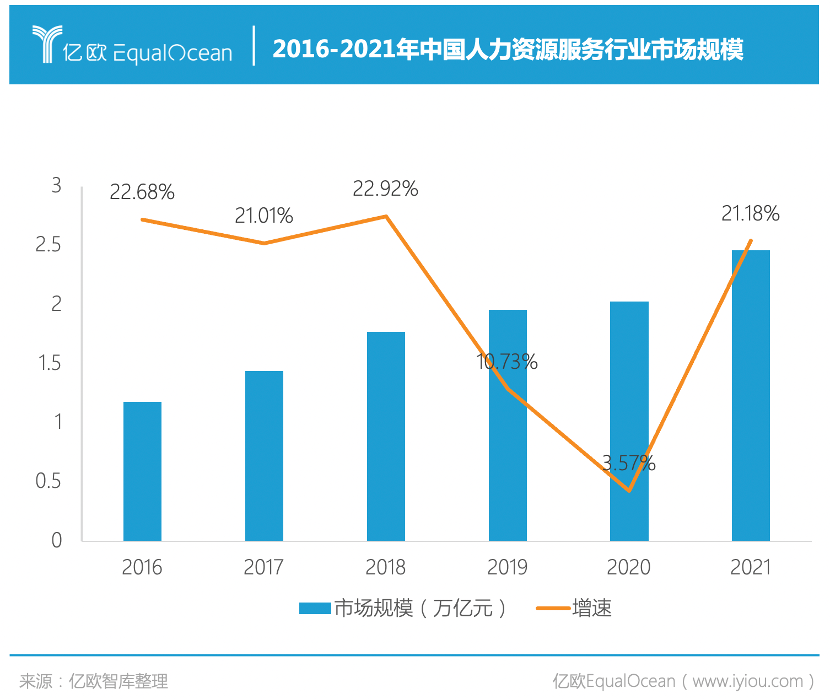 Under the background of technological progress, enhanced awareness of digital transformation of enterprises and normalization of epidemic situation, the demand for digital services of enterprises has increased, and the scale of digital human resources market will continue to grow rapidly. However, from the current scattered market structure, the digital transformation and development of human resources is still in the pioneering stage.
"Integration of industry and people" is the most popular concept of human resources digitalization in recent years, that is, the organizational structure centered on human resources has gradually changed into a business-centered structure, and business and human resources need to be integrated. HR SaaS has become a productivity tool for business managers, HRBP and employees, and the ultimate goal of HRSaaS is to help business departments achieve business success.
Taking Beisen as an example, its integrated HR SaaS and talent management platform iTalentX can help enterprises realize comprehensive digital management from employee recruitment, employment, management to resignation, rapidly improve talent management ability and improve human resource management efficiency. At present, Beisen has reached cooperation with more than 6,000 medium and large enterprises, 70% of which are top 500 enterprises in China.
In May this year, Beisen released version 5.0 of Italentx, which based on the concept of "business human integration", released more than 1,000 new features for business managers, store managers, HRBP, manufacturing line managers, HRSSC, HRD and other roles. Guided by strategy and business, it empowered managers, employees and BP with a digital platform to achieve deep integration between human resources and business operations.
Corresponding to integration, another route of human resources digitalization is the vertical specialization development of single module, which is cut into a vertical field of human resources and deeply cultivated for a long time to meet the big customers who have higher requirements for a single module. A large number of small and medium-sized enterprises have simple personnel structure, and often choose the most cost-effective digital service provider.
Yunsheng Group, established in 2015, takes the rigid demand of social security service as the starting point and makes the offline service process online. Yunsheng Group uses the combination of online SaaS technology and offline service network to effectively solve the pain points of industries such as complicated social security payment procedures, inefficiency and geographical restrictions. At present, it has opened 260 direct branches across the country, serving more than 16,000 enterprises and over 1.5 million employees.
Generally speaking, integrated service providers can meet the comprehensive needs of all aspects of enterprise human resource management, and the service targets focus on medium and large enterprise customers, so in terms of the scale of paying users and technical strength, integrated service providers such as Beisen are currently in the first camp. Players who cut into the vertical field are also seeking to change to integration, so as to win higher competitiveness.
Take Yunsheng Group as an example. After the social security and provident fund business matures, Yunsheng Group will connect traditional modules such as recruitment, back adjustment, entry and exit, social security/provident fund, salary, individual tax, commercial insurance and employee benefits in series to create a one-stop human resources digital service cloud platform "HRWORK Personnel Connect" and launch the enterprise-level HR SaaS platform "HRSaaS Steady Win Cloud". Through the offline service network layout and online service chain extension, Yunsheng Group also won a place in the industry.
At present, integration has become the general development trend of the industry. On the one hand, the digitalization of human resource management pays more attention to practical application, and continuous digging in a single module may lead to excess technology, and customers will not pay for it; On the other hand, integrated service providers are gradually "annexing" vertical enterprises, and the mature market structure will only be "giants" competing, and it will be difficult for single-module enterprises to compete with them if they do not transform.
What we can be sure is that no matter how the product or service model changes, human resource service providers and enterprise managers need to pay attention to the talents, ideas and values behind the technology with a global strategic vision.
Yi ou zhi kuResearch Report on Digital Development of Human Resources in China in 2022It will be officially released in early December, so please pay attention to more professional research and forward-looking perspectives.