Walking into the Second Medical Center of PLA General Hospital: Never give up when life depends on each other.
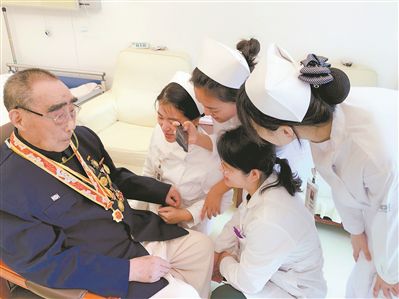
Full of reverence, medical staff listened to Zhao Shengrui, an old soldier of the New Fourth Army, introducing the story behind the medal. Photo by Li Bingjun
Every race with life is so thrilling.
In the Second Medical Center of PLA General Hospital, every medical staff, like Du Hui, the head nurse, has had more than one race with death.
Time and life—
Fight against time to win every minute of life for heroes and heroes.
Time is life. This sentence means a lot to them.
According to Wang Luning, an expert in neurology, "time is the brain", because every minute of delay in treatment, 1.9 million brain cells die.
In Professor Ye Ping’s view of time in cardiovascular medicine, 3 minutes is an important cutting point. If cardiac arrest exceeds the "golden three minutes", the brain tissue will be permanently damaged.
In the whole Second Medical Center, the medical staff here have a unified view of time-to win every minute of life for historical heroes with hard work against time.
In a sense, they go hand in hand with history. Liu Hong, who is responsible for the work of political assistants, still clearly remembers that scene-
That year, they visited the archives of the People’s Liberation Army in China. Looking at the heroes hanging on the wall, everyone was surprised to find that most of these heroes were their patients.
"We have seen these real heroes and watched them become historical figures." In the view of Zhang Li, chief physician of cardiovascular medicine, it is a sacred mission to silently provide medical care for these historical heroes.
Health care is different from ordinary medical care, and it may be unknown for a lifetime; Health care doctors don’t seem to be as nervous as doctors in emergency rooms and shadowless lamps, and they are often like "dancers on the tip of a knife".
The average age of patients is 88 years old, the average number of patients is nearly 10, and the average types of medication are 9.6 … This is a set of data from the front line of diagnosis and treatment in this center.
Different from other medical units, the patients here are old, with many basic diseases and complicated conditions, and often "lead the whole body".
Here, vital signs are monitored in single digits, and medication is often accurate to 1/4 or even 1/8 tablets.
Here, every consultation site is a high-end classroom, and many authoritative experts from specialties and sub-specialties gather on stage.
Here, even for ordinary routine diseases, there is no fixed diagnosis and treatment process, and an individualized and accurate plan must be formulated.
Life is more important than Mount Tai.
At the end of 2015, an academician of the Academy of Engineering who was tackling a major national scientific research project was diagnosed with advanced lung cancer. Facing the bad news, he told the medical staff: My personal life and death is not important, but the research project has not been completed yet. Can you give me another two years?
Considering that the patient’s physical condition does not allow surgery, the center immediately set up a "multidisciplinary team" to use the academician’s work gap to insert treatment, and finally extended his life span by five years until the scientific research project was completed.
When they came to the Second Medical Center, many patients felt very practical and full of trust. In their eyes, "this is a place full of miracles."
Behind the miracle of life, it comes from the unremitting climbing of doctors.
Academician Wang Shiwen successfully treated patients with 6 organ failures for 9 times, breaking the medical conclusion that more than 4 patients with organ failures died 100% abroad, and filling the research gap of emergency medicine for the elderly in the world;
The geriatric hematology team has been committed to the study of aplastic anemia for more than 20 years, and has become the gospel for patients suffering from "immortal cancer" to get rid of blood transfusion dependence;
In recent years, cardiac rehabilitation research has risen abroad, and the geriatric cardiac rehabilitation team in Cardiovascular Department has keenly "captured" this cutting-edge technology. They have broken the "forbidden zone" of geriatric cardiac rehabilitation and built a national standardized cardiac rehabilitation center …
This is a heroic team. The clinical department of the South Building of the People’s Liberation Army General Hospital, the predecessor of this center, was awarded the honorary title of "Model Medical Care Collective" by the Central Military Commission. Loyalty to health care, dedication, Excellence and courage to climb the peak are the common characteristics of these medical staff.
"Top the sky" should also "stand on the ground"-keeping a close eye on international cutting-edge concepts, tackling urgent national projects, establishing a national clinical medical research center for geriatric diseases, radiating to 31 provincial administrative regions and more than 300 medical units, and the discipline of geriatrics ranked first in the national specialist reputation list for five consecutive years.
"Treating diseases" also means "preventing diseases before they occur" —— establishing the concept of great health, changing the focus on treating diseases into the focus on patients’ health, innovating the general medical care model and improving patients’ quality of life.
"Seeing a doctor" also means "seeing a patient"-adhere to the close combination of medical ethics and medical skills, not only cure physical illness but also cure heart disease, so that patients can get better medical experience both physically and psychologically.
Youth and life—
The closer you are to the people’s heroes, the more you should charge like heroes.
On the academician wall of PLA General Hospital, an expert who is not an academician is also among them. He is an important pioneer of geriatrics in China-Mou Shanchu, a famous cardiologist and expert in internal medicine.
"What the old man said the most is that as long as the patient has something, call me at any time!" Li Xiaoying, an old student and expert in cardiovascular medicine, remembers that when he was 88 years old, he walked to the ward to save the patient. He fell when passing through the construction site, and half of his face was swollen at that time. The first sentence when he arrived at the ward was: "What is the patient’s situation now?"
Mou Shanchu is a "medical forest towering trees", but he says that he can’t live without patients. "My patients and I are like the friendship between plants and trees and the soil".
Well-known doctors, you can be like a Milky Way. The doctor’s light shining on Mou Lao has never faded, but shines under the inheritance of generations of medical staff in the center.
In the eyes of ordinary people, they are healers, who rejuvenate and treat the people; In the eyes of future generations, they are teachers, preaching and teaching, which makes people look up.
Nurses in hematology department can’t forget that Wang Jifang, an orthopedic expert in hospital, often takes off his hospital gown and puts on a white coat to consult, and his ward has become an "expert clinic" for inpatients.
Young doctors can’t forget that Zhao Yuxiang, the head nurse, walked off the emergency operating table, while his father, who was hospitalized just across the road, was critically ill and finally failed to get out of the rescue room.
Zhang Ziqi, an expert in gastroenterology for the elderly, can’t forget the two demands made by Zhao Donghai, an expert in gastroenterology, to the organization at the last stage of his life: First, to give up treatment and save resources for the country; The second is to donate the remains and make a final contribution to the medical cause.
Facing the call of the motherland and the people, they are not only doctors, but also white soldiers, soldiers of the Republic, and communist party member. They are desperate everywhere in the rescue and disaster relief scene of the Republic-
In the fight against SARS, Yang Li, winner of the Nightingale Award and deputy director of the nursing department, and his comrades-in-arms around him wrote down the gauntlet in succession, demanding to go to the front line of prevention and control and to the most dangerous places;
Wenchuan earthquake relief, many medical staff received the order to go out, and went straight to the airport before they had time to call their families;
In the fight against the COVID-19 epidemic, five experts, Ye Ping, Zhang Xi, Cheng Qingli, Lu Xuechun and Zhang Zhijian, arrived in Wuhan, plunged into the intensive care unit and devoted themselves to the front line of fighting the epidemic …
The closer you are to the people’s heroes, the more you should charge like a hero. In their ordinary posts, they exchanged their youth for the continuation of countless lives.
Engaged in nursing work for 37 years, the head nurse Huang Li still clearly remembers the scene:
That is not a real "old man". Although he is full of beautiful hair, he can no longer walk in the fields, but he is only in his early 60 s, showing his years of wind and frost;
That’s a real "scholar". Although he suffered from cancer, he set up a small table board on his hospital bed, and the dense drawings and formulas were counted for hours. Unconsciously, the hospital gown was soaked with sweat.
Until the end of his life, when his deeds were declassified, Huang Li knew that the patient in front of him was Deng Jiaxian, the "two bomb fathers" who made outstanding contributions to China’s nuclear weapons cause.
"From that moment on, I thought about it in my early 20 s. I will serve these historical heroes with love and hands in this life." Huang Li said this.
Growing up experiences are always strikingly similar.
On June 23rd, 2020, it was an unforgettable day for post-90s nurses.
Before this, the cancer cells of Academician Xu, the pioneer of Beidou, had spread all over the body, and the signs of life were weak, but he still insisted on listening to the news on the bedside radio every day.
Until that day, Xu Lao heard the news of the successful launch of Beidou-3 "Final Star" and fell into a coma that night. A few days later, Xu Lao died of illness.
When the satellite was launched, China’s scientific community lost a "star". The nurse realized that even at the end of Xu Lao’s life, Beidou was still the most concerned thing in her heart.
"What a glorious experience it is to be able to accompany the hero through the last journey of life." It is a series of such experiences that have accumulated a heavy youthful background for young medical staff.
That year, a female doctor who had worked in a local hospital for more than ten years and was specially recruited came to work in the center. The superior asked her to accompany an elderly patient for examination.
At first, she didn’t understand: such an ordinary old man can be accompanied by a nurse, so why should he accompany himself? Later, I learned that the old man in front of me was Xie Zhenhua, the national war hero and the founding major general.
"If you don’t say it, who knows that this is a hero who went to the battlefield without hesitation in the face of national disaster?" At that moment, the female doctor realized that in front of these revolutionary heroes, she and her comrades-in-arms represented not only doctors, but also the country and society.
Every historical hero is a vivid revolutionary history and a heavy textbook.
A newly graduated nurse said: After listening to their deeds, I knew that the patients who were nursing had shed blood and been injured for their hometown; Now it’s my turn to protect them and repay these historical heroes on behalf of my hometown.
"Unfamiliar names have gradually become familiar and have been restored into vivid images in the long river of history." The nurse told the reporter that approaching this group of revolutionary heroes who were completely unfamiliar before, what she gained from them was a heavy spiritual wealth.
In the eyes of the leaders of the center, seeing young medical staff spontaneously respect historical heroes, "let us see the inheritance and see the hope."
Happiness and life—
Nothing is more intoxicating than the smile on the faces of revolutionary predecessors.
It was a thrilling rescue.
An 86-year-old patient’s condition suddenly changed, and his digestive tract was bleeding heavily. The medical staff quickly established a venous channel for the patient and gave him pressurized blood transfusion …
"Your actions and spirit have made me feel the Yan ‘an style again." After several days of careful treatment, the patient’s condition was stable. Lying in the hospital bed, he raised his right hand trembling and gave a military salute to the medical staff at the scene!
This made all the medical staff present deeply feel their sense of self-worth and accomplishment.
Doctors are kind-hearted, perfect and beautiful.
"Caring for the elderly should be as meticulous and gentle as caring for babies", which is the standard of extreme nursing for Hou Huiru, the leader of geriatric nursing discipline, and her colleagues. Behind this sentence is ten years of silent dedication.
An old Red Army man who was hospitalized in bed for a long time, during the treatment period, the medical staff changed from batch to batch, but the nursing work was always consistent in standards, contents and details, creating a medical miracle of stable vital signs and no bedsore in bed for more than 10 years.
Doctors are born to be human and born to be human. For more than 30 years, the satisfaction rate of medical ethics in the center has always maintained 100%, and it has been rated as an advanced unit of medical ethics in the whole army. A patient wrote a thank-you letter: you have done what ordinary people can’t do, and you have done what your children can’t do.
Many patients who are hospitalized here make wills and voluntarily donate their bodies or organs to help clinical medicine and patients in need. This action, which shines with the brilliance of human nature, is the best interpretation of the unity of doctors and patients.
"Medical ethics does not simply emphasize not fame and fortune, but more importantly, the spirit of treating the people." Wang Luning, a 74-year-old expert, said that it is like a pure land, and everyone can find a sense of accomplishment in their careers.
That year, in order to help the center doctors master the heart bypass technique as soon as possible, Zhao Yigang, an old expert with heart disease, took the initiative to be the "first patient" and let young doctors operate on him.
Yu Senyang, a professor of respiratory medicine, said: "Medicine must be done as a career, not as an ordinary job. Doctors must have technology, but also’ technology with temperature’. "
No matter in which department, the two questions that medical staff ask the most every day are "Are you feeling better?" and "What’s wrong with you?". At the end of each communication, they never forget to encourage patients "You will get better and better".
The first thing to do at work every day is to make rounds, and the last thing to do after work is to make rounds, which is the habit of many doctors. Even on holidays, many doctors who are not on duty are used to walking around the ward.
In winter, they will first heat the stethoscope with their hands, and then auscultate the patient; When seeing a patient, he will help the patient to lie down slowly; After the inspection, I will slowly get up … The kindness of the doctor is quietly revealed in such details.
"There must be no rest on Saturday, not necessarily on Sunday." This has long been the norm for medical staff in the center. Nurse Zhou Cuiluan’s daughter writes a composition, and her ideal is to be a head nurse when she grows up, because "then she can schedule fewer shifts for her mother and spend more time with herself at home."
It not only rewards historical heroes, but also helps the whole world.
The plus sign is the norm for Wu Benyan, an expert in gastroenterology, to go out to the general clinic every time. His principle is: foreign patients, try to add; Critical patients must be added.
The "No.1 is hard to find" gastroenterologist always wants to see more patients. "It is my greatest happiness to see patients get rid of their illness."
In the eyes of these medical staff, medicine is a science that warms the mind with the heart. In the face of patients’ pain, they will always do their best to warm patients with sincerity.
"Nothing is more intoxicating than the smile on the faces of revolutionary predecessors." This is their collective view of happiness.
This is both simple and not so simple for medical staff. Recalling the interview scenes, the author suddenly remembered the inscription of an old soldier who resisted US aggression and aided Korea as the Second Medical Center: "There are a group of idealistic Republic military doctors here."
The persistent pursuit of life is the secret recipe of their happiness. (Zhang Shaobo)